There was a time when knowing how to “Google things” felt like a kind of superpower. If you were good at finding the right keywords, clicking through links, and piecing together information, you could learn just about anything. But lately, with AI tools like ChatGPT popping up everywhere, people are starting to ask a big question: Can AI replace Google?
It’s a fair question—one that brings up a mix of excitement, skepticism, and maybe a tiny bit of existential dread (especially if you’ve spent years mastering the art of online research). Let’s talk about what’s changing, what’s staying the same, and what it means for the way we search.
How AI and Google Are Different
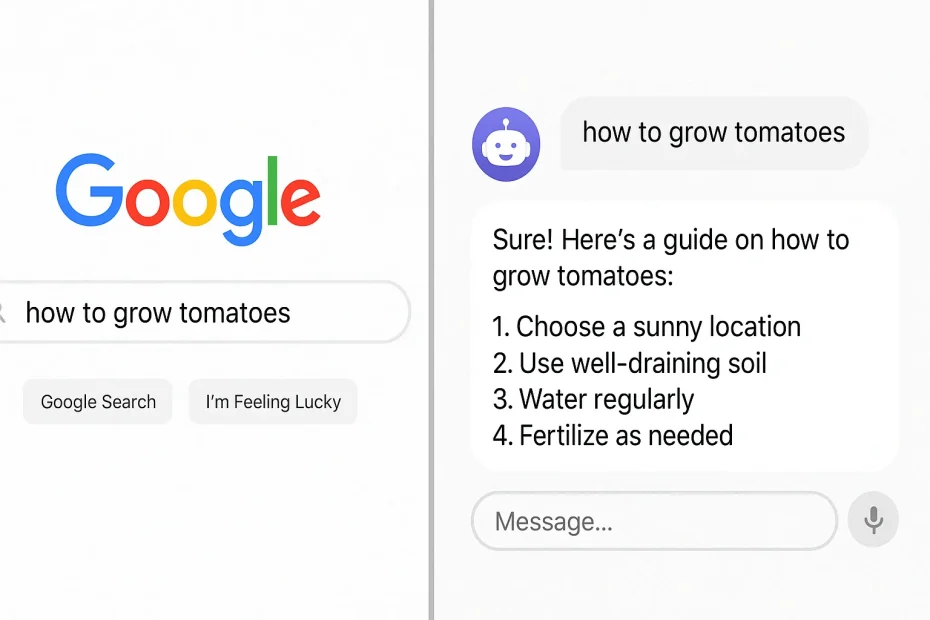
Google is a search engine. When you ask it something, it gives you a list of links. You have to sort through those links yourself and decide what’s useful.
AI, on the other hand, tries to skip that step. It gives you a direct answer—sometimes even in full paragraphs, with examples, summaries, or a little joke thrown in (if you’re lucky).
Think of it this way:
- Google: Here are 10 stores that might sell shoes. Go check them out.
- AI: Based on what I know, these are the best walking shoes for flat feet, and here’s why.
One is a librarian handing you a stack of books. The other is a helpful friend who’s already read the books and gives you the cliff notes.
Why This Shift Feels So Big
For years, we’ve been trained to “do our own research.” And honestly, that’s still a valuable skill. But now, we have tools that can do a lot of that research for us—and do it fast.
It’s a little unsettling at first. You might wonder: Are we becoming too dependent? Or: How do I know if what AI says is actually true?
These are good questions. And the answer is: use AI as a helper, not a final authority. Let it give you a starting point, then verify the info if it’s important. That’s especially true for health, finances, or anything with real-world consequences.
Can AI Fully Replace Google?
Not yet—and maybe not ever, at least not in the way we think. Here’s why:
- AI can hallucinate. (If you're not familiar with that term, check out our post on AI hallucinations.) It sometimes makes things up and sounds confident doing it.
- It doesn’t always cite sources. If you want to know where the info came from, Google is still better.
- Sometimes you want to browse. Looking for a restaurant, shopping for a gadget, or reading reviews? Google’s better for that kind of exploration.
But for quick summaries, brainstorming, writing help, and casual learning? AI is already amazing—and getting better fast.
How to Use Both Together
Instead of thinking in terms of “either-or,” try using AI and Google as a team:
- Start with AI to get a quick overview or a rough draft
- Use Google to fact-check, find real sources, or dig deeper
- Let each tool play to its strengths
And if ChatGPT throws in a pun about your in-laws while explaining quantum physics? That’s just bonus content.
The Big Picture
AI might not fully replace Google, but it’s definitely changing the way we find and understand information. It’s okay to feel a little weird about that. Every major shift in technology takes some getting used to.
The goal isn’t to stop researching or thinking critically—it’s to learn new ways to do both. And honestly, the fact that you’re even curious about this means you’re already adapting.
If you're new to using AI tools and want a gentle intro, check out our Beginner’s Guide to AI Tools.
Whether you’re team Google, team AI, or somewhere in between, the future of information is looking... interesting. And maybe just a little more fun. If you want to read more on this topic, check this page out.